
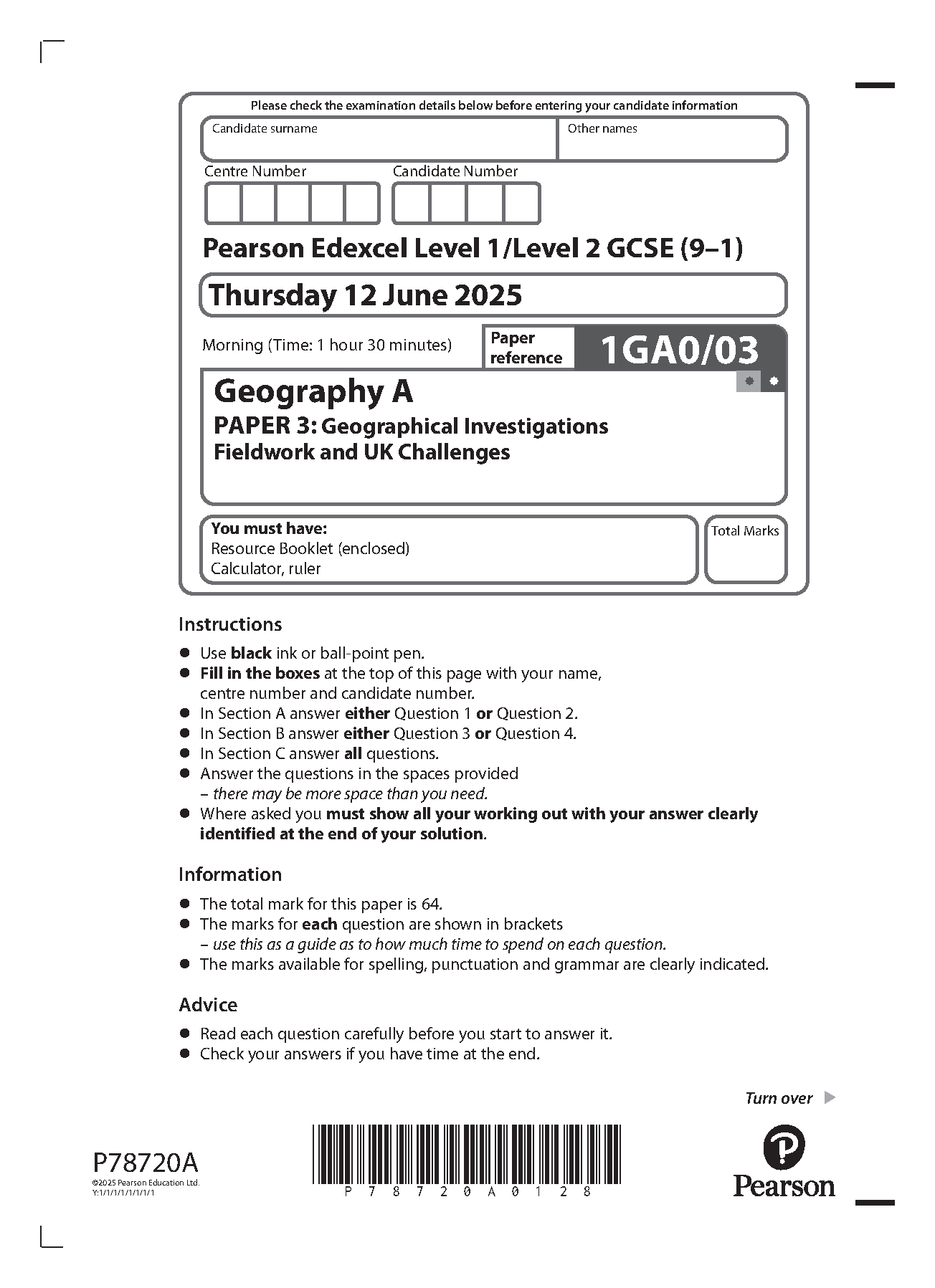

2025 Pearson Edexcel GCSE Geography A Paper 3 and Mark Scheme Combined (1GA0/03: Geographical Investigations Fieldwork and UK Challenges)
5.0
2025 Pearson Edexcel GCSE Geography A Paper 3 and Mark Scheme Combined (1GA0/03: Geographical Investigations Fieldwork and UK Challenges)
View example
Details
Comments
Reviews

2025 Pearson Edexcel GCSE Geography A Paper 3 and Mark Scheme Combined (1GA0/03: Geographical Investigations Fieldwork and UK Challenges)


🧭 Paper 3: What it is & overall details


  • Paper code: 1GA0/03. 


  • Title: Geographical Investigations: Fieldwork and UK Challenges. 


  • Duration: 1 hour 30 minutes. 


  • Total marks: 64 raw marks. Up to 4 of those marks are reserved for spelling, punctuation, grammar and use of specialist terminology (SPaG / specialist terms).


  • Weight: This paper contributes 25% of the overall Geography A GCSE qualification. revision.brinsworthacademy.org.uk+1


  • Content Covered:


    • Topic 7: Geographical investigations — fieldwork (physical and human environments)Topic 8: Geographical investigations — UK Challenges (i.e. applying geographical knowledge to a contemporary UK issue) 


🔧 Structure & Question Types


The exam paper is divided into three sections


Section A — Physical Environments (Fieldwork)


  • Candidates choose one of two optional questions: either focusing on Rivers or Coasts


  • This section tests understanding of physical geography fieldwork — data interpretation (maps, graphs, tables), investigation methods, analysis, conclusions, evaluation. 


  • Section A carries 18 marks


Section B — Human Environments (Fieldwork)


  • Candidates choose one of two optional questions: either on Urban (Central/Inner Urban Area) or Rural Settlements. Assesses human geography fieldwork: sampling methods, qualitative/quantitative data, data presentation and interpretation, evaluation of methodology, human-environment interactions etc.


  • Section B also carries 18 marks.


Section C — UK Challenges


  • This section examines a broader UK‑wide geographical issue (from Topic 8). Candidates answer all questions in this section.  


  • Questions include a mix: multiple‑choice, short open‑response, data analysis / calculations, and extended writing tasks (8‑mark and 12‑mark answers). 


  • Total marks for Section C: 28 marks (including up to 4 SPaG / specialist‑terminology marks on final extended question). 


Overall, the paper uses a variety of question styles: multiple-choice, short answer, data‑response, calculations, and structured and extended writing. 


🎯 What It Tests — Skills & Knowledge


Students are assessed on:


  • Understanding of fieldwork methods (both physical and human): data collection techniques, sampling, risk management, ethical considerations, reliability/validity of data. 


  • Ability to interpret and analyse data from maps, graphs, tables — to draw conclusions and recognise patterns/trends. 


  • Understanding of geographical processes and human–environment interactions — within UK context and more broadly. 


  • Critical thinking and evaluation: assessing strengths/weaknesses of methods, judging sustainability or trade‑offs, considering multiple factors (economic, social, environmental) when discussing UK Challenges. Communication: structuring answers clearly, using appropriate geographical terminology, writing coherent extended responses, accurate spelling/punctuation/grammar (SPaG). 


✅ What it Means for Students — What to Prepare


  • You need experience of at least two fieldwork investigations: one physical (river or coast) and one human (urban or rural). Understand the enquiry process: from question formulation → data collection → analysis → conclusion → evaluation. 


  • Be ready to deal with unfamiliar data in the exam — maps, graphs, tables, charts — and be able to interpret and use them even if you didn’t collect them yourself. 


  • Develop skills in geographical writing: concise answers for short questions; structured responses for longer ones (8‑mark, 12‑mark). Practice writing with clear argument, supporting evidence, evaluation and conclusions.


  • For the UK Challenges section: revise possible UK issues (e.g. population/resource pressures, settlement inequalities, environmental pressures, climate change) and understand their physical and human geography aspects. 


  • Work on data handling and calculations (mean, trends, interpreting graphs/maps) as these often appear.


  • Practice time‑management: total 1h30 for whole paper — roughly split between (A) physical fieldwork question, (B) human fieldwork question, and (C) UK challenges section.